Digital vs Physical Baby Books: Which is Right for You?
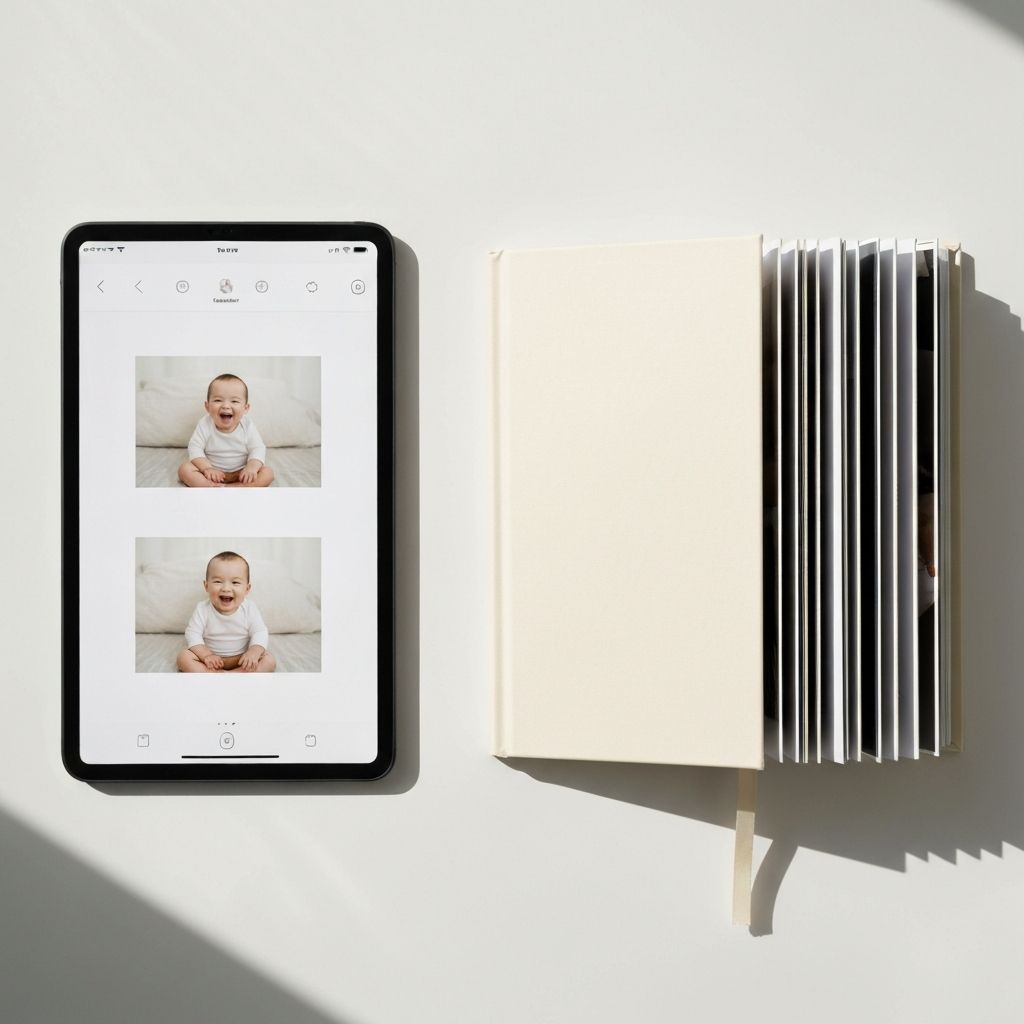
Here's a sobering reality: research from Springer shows that parents fail to retrieve nearly 40% of their digital photos when searching for images from just over a year ago. Meanwhile, that beautiful leather-bound baby book on your shelf? Studies show most remain less than half completed.
Both digital and physical baby books have passionate advocates—and legitimate drawbacks. In 2025, parents are increasingly concerned about privacy, organization, and ensuring their precious memories survive the test of time. This guide will help you make an informed choice based on your family's unique needs.
40%
of digital photos parents can't find when needed
50%+
of physical baby books remain incomplete
73%
of parents worry about cloud photo privacy
In This Article
Understanding Physical Baby Books
Physical baby books have been cherished for generations. There's something irreplaceable about turning actual pages, feeling the weight of memories in your hands, and sharing a tangible keepsake with your child years later.
Advantages of Physical Books
Tangible & Tactile Experience
Research shows that handwriting boosts memory retention and emotional connection. The physical act of placing photos and writing notes creates deeper engagement.
No Technology Required
Won't become obsolete due to software updates, file format changes, or company shutdowns. Works without batteries, internet, or accounts.
Distraction-Free Viewing
No notifications, no app switching, no screen fatigue. Pure, focused memory-sharing moments with your family.
Heirloom Quality
A beautifully crafted baby book can be passed down through generations, becoming a treasured family artifact.
Disadvantages of Physical Books
Vulnerable to Damage
Fire, flood, spills, or simple wear and tear can destroy irreplaceable memories. Once lost, they're gone forever.
Time-Intensive
Printing photos, cropping, arranging, writing captions—the process requires significant time that exhausted new parents often don't have.
Prescriptive Structure
Many pre-made baby books have fixed templates that don't match your child's actual milestones, leading to blank pages or forced entries.
Limited Capacity
Physical books hold a finite number of photos. No room for videos, audio recordings, or the hundreds of photos modern parents capture.
Understanding Digital Baby Books
Digital baby books and family photo apps have evolved significantly. Modern solutions offer AI-powered organization, cloud backup, and seamless sharing—addressing many traditional pain points while introducing new considerations.
Advantages of Digital Books
Unlimited Storage
Store thousands of photos and videos without physical constraints. Capture every moment without worrying about running out of pages.
Automatic Backup
Cloud storage means your memories survive device loss, damage, or theft. Proper backup eliminates the single-point-of-failure risk.
Searchable & Organized
Find specific photos instantly with tags, dates, or AI-powered search. No more flipping through hundreds of prints.
Easy Sharing
Share with grandparents, relatives, and friends instantly. Private family albums keep memories accessible to those who matter.
Multimedia Support
Capture videos, audio clips, and photos together. Hear your baby's first words, not just see a photo of the moment.
Disadvantages of Digital Books
Privacy Concerns
According to Proton research, 73% of UK parents are concerned about how cloud providers might access and use their children's photos.
Technology Dependency
Requires devices, internet, accounts, and ongoing service availability. What happens if the company shuts down or changes its terms?
Retrieval Challenges
Research shows parents fail to find 40% of photos from just a year ago. Poor organization habits lead to "digital chaos."
Screen Fatigue
Viewing memories on the same device where notifications compete for attention can diminish the emotional impact of the experience.
Side-by-Side Comparison
| Feature | Physical | Digital |
|---|---|---|
| Upfront Cost | $20-$100 | Free-$10/mo |
| Storage Capacity | 50-200 photos | Unlimited* |
| Backup Security | Single copy | Cloud redundancy |
| Sharing | In-person only | Instant, remote |
| Searchability | Manual browsing | AI-powered search |
| Video Support | ||
| Audio Clips | ||
| Works Offline | Varies | |
| Privacy Control | Varies | |
| Longevity | Decades (if preserved) | Depends on service |
*Subject to subscription plan limits
Which Should You Choose?
The best choice depends on your priorities, lifestyle, and how you envision sharing these memories in the future.
Choose Physical Books If You...
- Value the tactile experience of turning pages and handwritten notes
- Want a guaranteed tech-free keepsake that will work in 50 years
- Have concerns about digital privacy and data ownership
- Prefer curated, intentional collections over comprehensive archives
- Plan to create a heirloom to pass down through generations
Choose Digital Books If You...
- Want to capture everything—including videos and audio
- Need to share memories with remote family members regularly
- Prefer automatic organization and AI-powered search
- Have limited time for manual photo printing and arranging
- Want protection against physical damage or loss
The Hybrid Approach: Best of Both Worlds
Many modern parents are discovering that the debate isn't either/or—it's both/and. A hybrid approach leverages the strengths of each format while mitigating their weaknesses.
The Hybrid Strategy
- 1
Capture Everything Digitally
Use your phone, wearable camera, or dedicated device to capture moments without limits.
- 2
Organize with Digital Tools
Let AI help you tag, sort, and identify the best shots from thousands of images.
- 3
Print the Highlights
Select your favorite moments and create a beautiful physical book annually or quarterly.
- 4
Maintain Digital Archive
Keep the full collection safely backed up in the cloud for videos, extras, and searchability.
How Eukka Bridges the Gap
Eukka was designed with the hybrid approach in mind. Our AI-powered wearable camera captures moments hands-free, then automatically organizes and transforms them into beautiful, shareable formats.
Capture Without Limits
Our wearable camera records throughout the day, so you never miss a moment—even when your hands are full.
AI Organization
Smart detection identifies smiles, milestones, and precious moments automatically, solving the 40% retrieval problem.
Creative Outputs
Transform daily footage into AI comics, smart vlogs, and curated highlight reels perfect for printing or sharing.
Privacy First
Your memories stay yours. Local processing options and transparent data policies give you control.
Final Thoughts
Whether you choose digital, physical, or a hybrid approach, the most important thing is that you're intentionally preserving memories. The "best" baby book is the one you'll actually use consistently.
For many modern families, technology has made it possible to capture more moments than ever before—while still creating tangible keepsakes that will be treasured for generations to come.
References
- [1] Springer Link - "Personal and Ubiquitous Computing: Photo Retrieval Practices" - Research showing parents fail to find 40% of digital photos. link.springer.com
- [2] Proton Blog - "UK Parents Photo Privacy Study 2025" - Survey data on parental privacy concerns with cloud storage. proton.me
- [3] Our Fable Journal - "Why Traditional Baby Books Fail" - Analysis of prescriptive structure limitations. ourfable.ai
- [4] TeleCompetitor - "Study Finds Chaotic Digital Photo Storage Habits" - Research on digital organization challenges. telecompetitor.com
- [5] Nanit Parent Forward Report 2025 - Insights on modern parenting approaches and memory preservation. prnewswire.com